Disasters don’t strike often, but when they do, you rarely know how long you’ll be stuck in the situation, when help is going to come (if ever), and what’s coming next. Sometimes the best thing you can do is hold on and hope for the best. In these situations, practical survival products make life easier.
1 – Handbooks and Notebooks
By far the most useful thing you can get for yourself, even if you’re an experienced survivalist, is a survival handbook, or even better, handbooks.
Nobody knows everything, and these things have a wealth of information that can make the difference between living and dying. There are handbooks specialized in foraging for food, and by following them, you can avoid poisonous or spoiled foods, build traps, hunt, and generally just learn where to look for prey, fruits, and vegetables.
Handbooks on shelter building will teach you how to insulate your shelter and keep yourself safe from the elements, while handbooks on navigation will help you find sanctuary.
Whatever the specific aspect of survival may be, there’s a handbook for it written by an expert (often ex-military) who actually tested this stuff out in real life. It would also be useful to keep at least one notebook on your person (preferably a waterproof one – yes, they exist) to make notes on the things you see, things you should avoid, and the direction you’re taking.
Read: How to Choose the Right Lift Supports for Your Car Hood, Trunk, or Tailgate
2 – Duct Tape
There’s a saying in the world of engineers: “If it’s still wobbly, use more duct tape.” This is not that far removed from survival!
Duct tape is a universally adored and useful tool because you can use it for literally everything.
Your knife handle is falling apart? Duct tape.
The tarp on your shelter ripped open? Duct tape.
You need to keep the bandage on your wound tight and immobilized? Believe it or not, duct tape.
Duct tape was originally designed for use on airplanes, which means it’s high-strength and long-lasting. It is by far one of the most useful tools you could have in your survival kit, and you can fix pretty much anything with it.
3 – Light Sticks
Light sticks are your backup in case your flashlight runs out of juice. This is why it’s always recommended to get one of those cranking flashlights, as they can provide light almost indefinitely.
We find the alternative in light sticks, which aren’t too bad as a last resort: they don’t take up any room in your pack and are extremely light and long-lasting. A no-brainer!
4 – Tarp
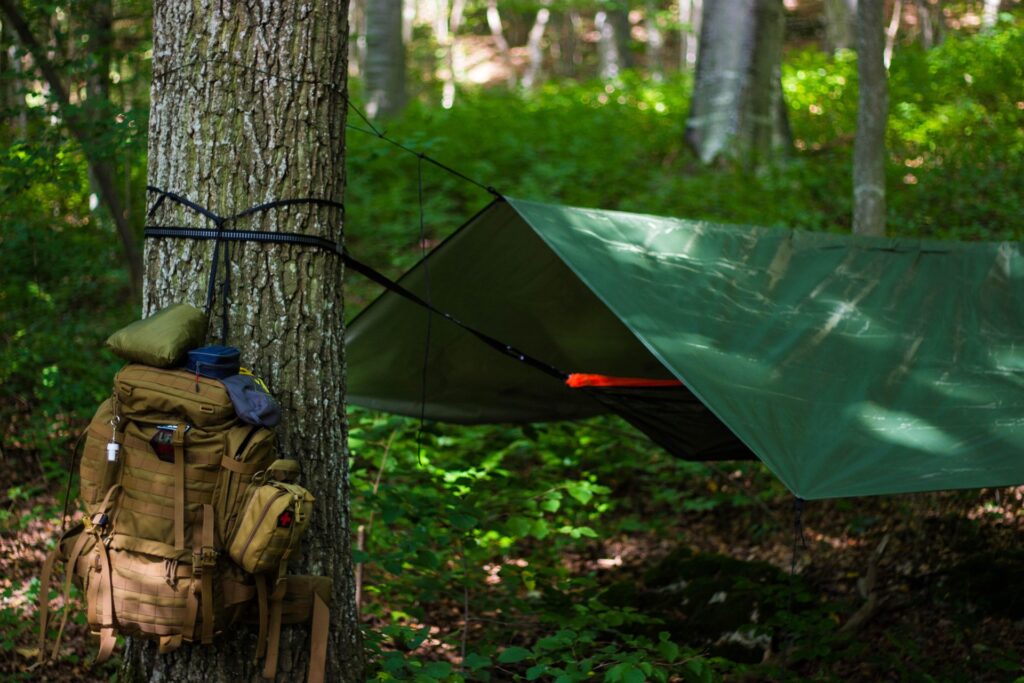
Like duct tape, do you have any idea how many things you can do with a tarp?
You can use it to put a roof over your head when building a shelter, turn it into a tent, hide your supplies by burying them in the ground (a tarp will keep them safe from burrowing animals), and hang stuff on trees. Tarp can, in fact, be used as a substitute for blankets and clothing. If you buy a waterproof tarp, you can cut it into a raincoat.
A tarp can be used to carry water, trap animals, or collect berries. It’s extremely likely that the human race still hasn’t maximized the theoretical usefulness of the humble tarp. If you think about it, tarp, duct tape, and rope might be the three most useful emergency kit products ever made.
5 – A Portable Toilet
Something that people are especially sensitive about in emergency scenarios is our private business. We witnessed this quite recently during the COVID-19-fueled toilet paper frenzy, when everyone was stocking up on it as if it were made of gold.
Another extremely useful product in this regard is the portable toilet. These things are very cheap, but they make the difference between going number two comfortably and having to improve in adverse conditions.
Portable toilets are easy to set up, come with toilet bags, and, to put it simply, they’re way more comfortable than digging a hole in the ground.
6 – Hand Warmers
Hand warmers are specifically useful in cold environments. They provide hours of continuous warmth and are mostly reusable (to a degree).
Aside from providing comfort, they’re extremely important for keeping your hands functional. As your body gets colder, it starts shunting blood from your extremities to your torso and head to keep your heart, brain, and other vital organs warm. This is why you start losing sensation in your hands and feet after being out in the cold for a while.
Hand warmers will not only make this less uncomfortable, but they’ll also improve your hand dexterity. So, for example, if you have to handle a firearm in the extreme cold, your shooting will be more accurate simply because your hand movements are more precise.
7 – Headlamps
Flashlights are great, but headlamps are really the way to go if you want both hands free when working in the dark. They’re the logical upgrade upon the everyday flashlight, and they’re one of the simplest ways to improve your overall movement ability in the dark.
8 – Sleeping Bags

This may be a bit obvious, but a lot of people still like to cover themselves with a blanket instead of simply using a sleeping bag. Sleeping bags come with less fuss than regular blankets, and they’re better at overall insulation as they completely cover your body.
They are also easier to pack in your emergency kit and don’t require an everyday setup. If you ever have to choose between a sleeping bag and a regular blanket, get a sleeping bag, and this goes double for anyone preparing for an emergency in especially cold areas. Sleeping bags are some of the most important military survival gear ever created, and there’s a reason everyone relies on them.